
Unifying a fragmented property management
platform into a cohesive system
Unifying a fragmented property
management platform into
a cohesive system
Unifying a fragmented
property management
platform into
a cohesive system
OVERVIEW
I.
Unifying complex property
management workflows
Unifying complex property
management workflows
Unifying complex property
management workflows
Disponent is a property management platform
under Confirma Software — one of several
Confirma products our team has worked on —
designed for Finnish housing management
companies. It centralizes property portfolios,
financial operations, tenant records,
and regulatory compliance — scaling
from independent managers to large agencies.
Disponent is a property management platform
under Confirma Software — one of several Confirma
products our team has worked on — designed
for Finnish housing management companies.
It centralizes property portfolios, financial
operations, tenant records, and regulatory
compliance — scaling from independent managers
to large agencies.
Disponent is a property management
platform under Confirma Software — one
of several Confirma products our team
has worked on — designed for Finnish
housing management companies.
It centralizes property portfolios, financial
operations, tenant records, and regulatory
compliance — scaling from independent
managers to large agencies.
Disponent is a property management platform
under Confirma Software — one of several Confirma
products our team has worked on — designed
for Finnish housing management companies.
It centralizes property portfolios, financial
operations, tenant records, and regulatory
compliance — scaling from independent managers
to large agencies.
We worked across 14 distinct product areas,
rebuilding existing core flows and designing new
capabilities to establish a standardized, cohesive
platform experience.
We worked across 14 distinct product areas,
rebuilding existing core flows and designing new
capabilities to establish a standardized, cohesive
platform experience.
We worked across 14 distinct product areas,
rebuilding existing core flows and designing
new capabilities to establish a standardized,
cohesive platform experience.
We worked across 14 distinct product areas,
rebuilding existing core flows and designing new
capabilities to establish a standardized, cohesive
platform experience.
14
1
Product modules covered —
from financial operations and task
management to maintenance planning
Product modules covered —
from financial operations and task
management to maintenance
planning
Product modules covered —
from financial operations
and task management
to maintenance planning
Product modules covered — from financial
operations and task management
to maintenance planning
Standardized interaction model — established
across previously fragmented product
areas and workflows
Standardized interaction model —
established across previously
fragmented product areas
and workflows
Standardized interaction
model — established
across previously
fragmented product
areas and workflows
Standardized interaction model —
established across previously fragmented
product areas and workflows
PROBLEM
ii.
A fragmented system
hindering market adoption
A fragmented
system hindering
market adoption
A fragmented system
hindering market adoption
Years of independent development
by distributed teams resulted in inconsistent
interaction patterns across the platform, creating
usability friction that pilot customers cited
as a primary complexity barrier.
Years of independent development
by distributed teams resulted in inconsistent
interaction patterns across the platform,
creating usability friction that pilot customers
cited as a primary complexity barrier.
Years of independent development
by distributed teams resulted
in inconsistent interaction patterns
across the platform, creating usability
friction that pilot customers cited
as a primary complexity barrier.
Years of independent development by distributed
teams resulted in inconsistent interaction patterns
across the platform, creating usability friction
that pilot customers cited as a primary
complexity barrier.
Dual-scope navigation caused user disorientation
Dual-scope navigation caused
user disorientation
Dual-scope navigation caused
user disorientation
Dual-scope navigation caused
user disorientation
Switching between office-wide management and individual housing company property
operations forced users back to the root page, interrupting workflows and making
it harder to move between operational levels.
Switching between office-wide management and individual housing
company property operations forced users back to the root page,
interrupting workflows and making it harder to move between
operational levels.
Switching between office-wide management
and individual housing company property
operations forced users back to the root page,
interrupting workflows and making it harder
to move between operational levels.
Switching between office-wide management
and individual housing company property
operations forced users back to the root page,
interrupting workflows and making it harder to move
between operational levels.
Task management lacked operational hierarchy
Task management lacked
operational hierarchy
Task management lacked
operational hierarchy
Task management lacked
operational hierarchy
High-volume workflows — which could reach anywhere from 20 to 130 subtasks — lacked
a parent-child structure, creating severe friction during task creation and slowing down
team-wide progress tracking.
High-volume workflows — which could reach anywhere from 20
to 130 subtasks — lacked a parent-child structure, creating severe
friction during task creation and slowing down team-wide
progress tracking.
High-volume workflows — which could reach
anywhere from 20 to 130 subtasks — lacked
a parent-child structure, creating severe friction
during task creation and slowing down team-wide
progress tracking.
High-volume workflows — which could reach
anywhere from 20 to 130 subtasks — lacked
a parent-child structure, creating severe friction
during task creation and slowing down team-wide
progress tracking.
Invoice approval lacked contextual decision support
Invoice approval lacked contextual
decision support
Invoice approval lacked
contextual decision support
Invoice approval lacked contextual
decision support
Reviewing batches required constant context-switching between invoice records
and source documentation, obscuring decision histories.
Reviewing batches required constant context-switching between
invoice records and source documentation, obscuring
decision histories.
Reviewing batches required constant context-
switching between invoice records and source
documentation, obscuring decision histories.
Reviewing batches required constant context-
switching between invoice records and source
documentation, obscuring decision histories.
Maintenance planning failed under complex regulatory
data models
Maintenance planning failed under complex
regulatory data models
Maintenance planning failed
under complex regulatory
data models
Maintenance planning failed under
complex regulatory data models
A mandatory three-tier structure (project, activity, work target) sat in a constrained
creation view with rigid status tracking that could not reflect real-world execution.
A mandatory three-tier structure (project, activity, work target) sat
in a constrained creation view with rigid status tracking
that could not reflect real-world execution.
A mandatory three-tier structure (project, activity,
work target) sat in a constrained creation view
with rigid status tracking that could not reflect
real-world execution.
A mandatory three-tier structure (project, activity,
work target) sat in a constrained creation view
with rigid status tracking that could not reflect
real-world execution.
OUR APPROACH
iii.
One design standard, applied
to each operational area
One design standard,
applied to each
operational area
One design standard, applied
to each operational area
The engagement focused on establishing
interaction consistency across the platform,
optimizing primary operational touchpoints,
and designing new capabilities tailored to daily
property management operations.
The engagement focused on establishing
interaction consistency across the platform,
optimizing primary operational touchpoints,
and designing new capabilities tailored to daily
property management operations.
The engagement focused on establishing
interaction consistency across the platform,
optimizing primary operational touchpoints,
and designing new capabilities tailored
to daily property management operations.
The engagement focused on establishing
interaction consistency across the platform,
optimizing primary operational touchpoints,
and designing new capabilities tailored to daily
property management operations.
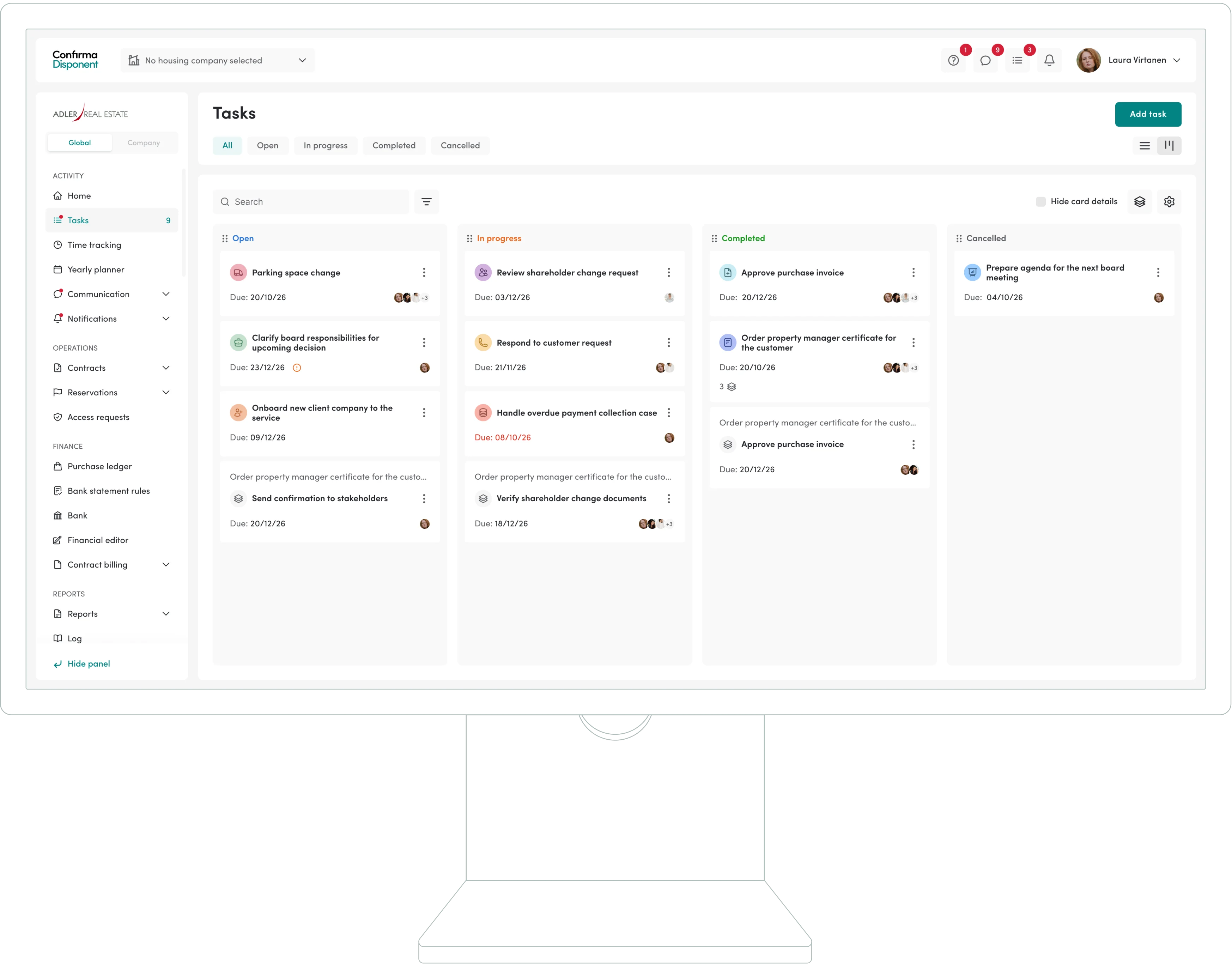
Engineered a context-preserving scope toggle
Engineered a context-preserving
scope toggle
Engineered a context-
preserving scope toggle
Engineered a context-preserving
scope toggle
Introduced a global-to-company toggle at the navigation head, allowing users
to switch operational depth without losing their active property context.
Introduced a global-to-company toggle at the navigation head,
allowing users to switch operational depth without losing their
active property context.
Introduced a global-to-company toggle
at the navigation head, allowing users
to switch operational depth without losing
their active property context.
Introduced a global-to-company toggle
at the navigation head, allowing users
to switch operational depth without losing
their active property context.
Structured dual-view task management
Structured dual-view task management
Structured dual-view
task management
Structured dual-view task
management
Designed structured list and Kanban views backed by a hierarchical parent-subtask
model and streamlined batch-entry controls.
Designed structured list and Kanban views backed
by a hierarchical parent-subtask model and streamlined
batch-entry controls.
Designed structured list and Kanban
views backed by a hierarchical parent-
subtask model and streamlined
batch-entry controls.
Designed structured list and Kanban views
backed by a hierarchical parent-subtask
model and streamlined batch-entry controls.
Implemented a split-screen invoice review workspace
Implemented a split-screen invoice
review workspace
Implemented a split-screen
invoice review workspace
Implemented a split-screen
invoice review workspace
Positioned source documents directly alongside transaction records, enabling
side-by-side verification and visible audit trails.
Positioned source documents directly alongside transaction
records, enabling side-by-side verification and visible
audit trails.
Positioned source documents directly
alongside transaction records, enabling
side-by-side verification and visible
audit trails.
Positioned source documents directly
alongside transaction records, enabling
side-by-side verification and visible
audit trails.
Re-architected complex maintenance
planning hierarchies
Re-architected complex maintenance
planning hierarchies
Re-architected
complex maintenance
planning hierarchies
Re-architected complex
maintenance planning hierarchies
Separated creation from editing, introduced collapsible nesting for complex
projects, and expanded status models to reflect off-platform regulatory updates.
Separated creation from editing, introduced collapsible nesting
for complex projects, and expanded status models to reflect
off-platform regulatory updates.
Separated creation from editing, introduced
collapsible nesting for complex projects,
and expanded status models to reflect
off-platform regulatory updates.
Separated creation from editing, introduced
collapsible nesting for complex projects,
and expanded status models to reflect
off-platform regulatory updates.
RESULTS
iv.
A product experience
that scales across
complex workflows
A product experience
that scales across
complex workflows
1
Unified interface — Transformed a fragmented, multi-team codebase
into a standardized, cohesive platform, directly resolving the usability
and complexity barriers flagged during customer pilots.
Unified interface — Transformed a fragmented, multi-
team codebase into a standardized, cohesive platform,
directly resolving the usability and complexity barriers
flagged during customer pilots.
Unified interface — Transformed
a fragmented, multi-team codebase
into a standardized, cohesive platform,
directly resolving the usability
and complexity barriers flagged during
customer pilots.
Unified interface — Transformed
a fragmented, multi-team codebase
into a standardized, cohesive platform,
directly resolving the usability
and complexity barriers flagged during
customer pilots.
14
Product areas optimization — Worked across 14 existing and new product
areas to re-engineer high-friction operational flows, introduce essential new
capabilities, and establish consistent UI/UX standards across the platform.
Product areas optimization — Worked across 14 existing
and new product areas to re-engineer high-friction
operational flows, introduce essential new capabilities,
and establish consistent UI/UX standards across
the platform.
Product areas optimization — Worked
across 14 existing and new product areas
to re-engineer high-friction operational
flows, introduce essential new
capabilities, and establish consistent
UI/UX standards across the platform.
Product areas optimization — Worked
across 14 existing and new product areas
to re-engineer high-friction operational
flows, introduce essential new capabilities,
and establish consistent UI/UX standards
across the platform.

Contact
Tell us what you're working on.
We'll respond
within one business day.
You've submitted recently
We'll review your message and respond
within one business day.
