
Turning a multi-week private-market process
into one clear path
Turning a multi-week private-market
process into one clear path
Turning a multi-week
private-market process
into one clear path
OVERVIEW
I.
Rebuilding depth and progress
for both sides of the trade
Rebuilding depth and progress
for both sides of the trade
Rebuilding depth and progress
for both sides of the trade
Rebuilding depth and
progress for both sides
of the trade
Meridian is a venture trading platform connecting
buyers and sellers of private-market assets —
tender offers, negotiated trades, and fund/LP
interests. Buyers range from first-time investors
to institutional allocators, and transactions can
unfold over weeks with real gaps between steps.
We led a redesign of the platform's core buying
and selling experience, centered
on understanding what each user type actually
needed and shaping one adaptable interface
around those differences.
Meridian is a venture trading platform connecting
buyers and sellers of private-market assets —
tender offers, negotiated trades, and fund/LP
interests. Buyers range from first-time investors
to institutional allocators, and transactions can
unfold over weeks with real gaps between steps.
We led a redesign of the platform's core buying
and selling experience, centered on understanding
what each user type actually needed and shaping
one adaptable interface around those differences.
Meridian is a venture trading platform
connecting buyers and sellers of private-
market assets — tender offers, negotiated
trades, and fund/LP interests. Buyers range
from first-time investors to institutional
allocators, and transactions can unfold over
weeks with real gaps between steps.
We led a redesign of the platform's core
buying and selling experience, centered
on understanding what each user type
actually needed and shaping one adaptable
interface around those differences.
Meridian is a venture trading platform connecting
buyers and sellers of private-market assets —
tender offers, negotiated trades, and fund/LP
interests. Buyers range from first-time investors
to institutional allocators, and transactions can
unfold over weeks with real gaps between steps.
We led a redesign of the platform's core buying
and selling experience, centered on understanding
what each user type actually needed and shaping
one adaptable interface around those differences.

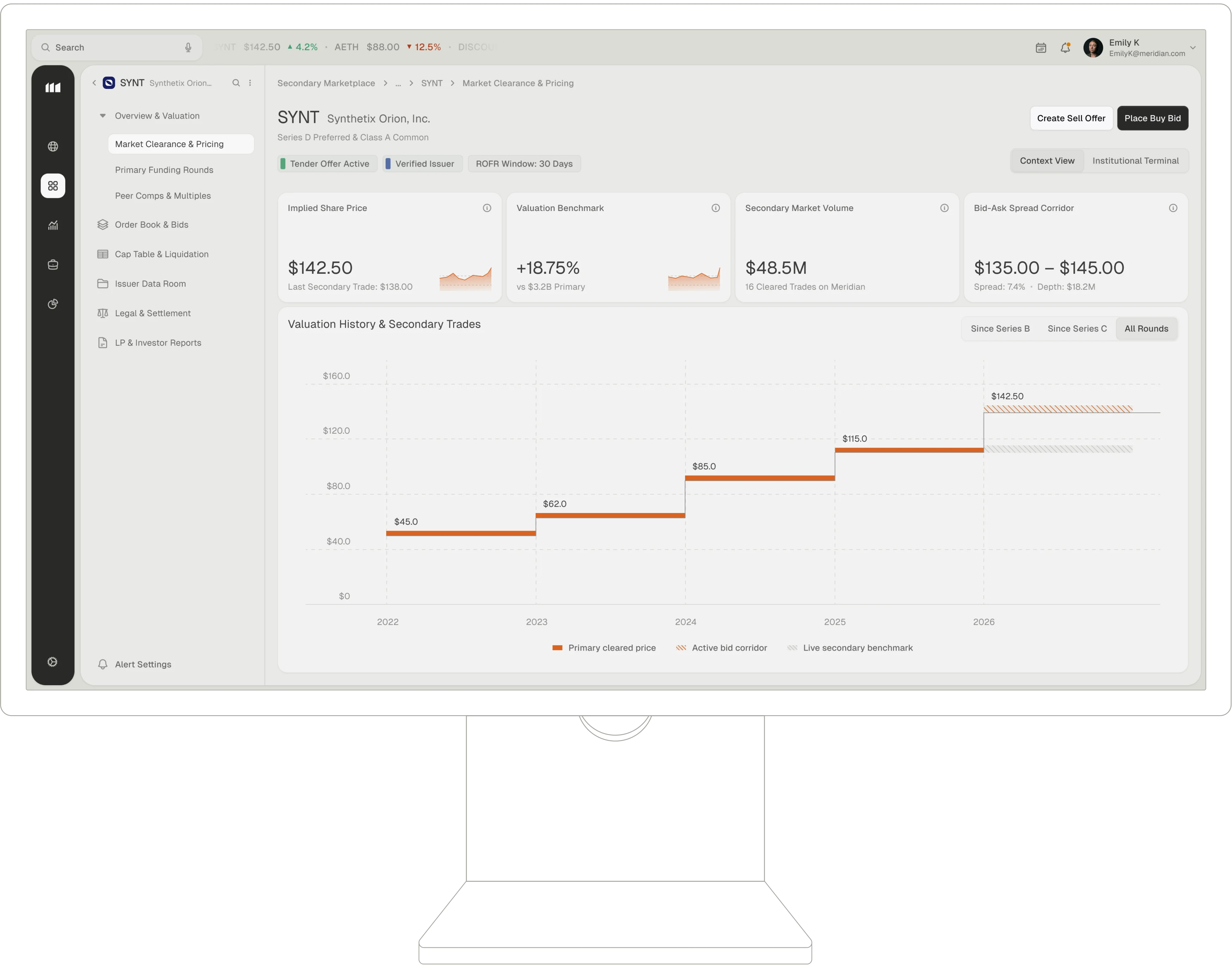
The interface shown reflects the design at the time
of our engagement and may differ from the current product.
The interface shown reflects the design at the time
of our engagement and may differ from the current product.
The interface shown reflects the design
at the time of our engagement and may differ
from the current product.
The interface shown reflects the design
at the time of our engagement and may differ
from the current product.
2
1
Specialized viewing modes merged into 1
adaptable interface
Specialized viewing modes merged
into 1 adaptable interface
Specialized viewing
modes merged into 1
adaptable interface
Specialized viewing modes merged into 1
adaptable interface
Consistent flow pattern with 3 structurally
distinct transaction types
Consistent flow pattern with 3
structurally distinct transaction types
Consistent flow pattern
with 3 structurally distinct
transaction types
Consistent flow pattern with 3 structurally
distinct transaction types
PROBLEM
ii.
Getting the split right once
wasn't enough
Getting the split right
once wasn't enough
Getting the split right once
wasn't enough
Three main gaps surfaced as the platform scaled:
the buying flow served two incompatible buyer
types at once, sellers lost track of a process
that stretched across two weeks, and transaction
types didn't share a consistent interface.
Three main gaps surfaced as the platform scaled:
the buying flow served two incompatible buyer
types at once, sellers lost track of a process
that stretched across two weeks, and transaction
types didn't share a consistent interface.
Three main gaps surfaced as the platform
scaled: the buying flow served two
incompatible buyer types at once, sellers
lost track of a process that stretched
across two weeks, and transaction types
didn't share a consistent interface.
Three main gaps surfaced as the platform scaled:
the buying flow served two incompatible buyer
types at once, sellers lost track of a process
that stretched across two weeks, and transaction
types didn't share a consistent interface.
A buying flow trying to serve two buyers,
and serving neither
A buying flow trying to serve two buyers,
and serving neither
A buying flow trying to serve two
buyers, and serving neither
A buying flow trying to serve two
buyers, and serving neither
The platform had already gotten one split right: buyers and sellers have opposite needs,
and the interface correctly treated them as distinct experiences. But that same logic
wasn't carried one level deeper. First-time buyers, qualifying by wealth rather than market
experience, were dropped into the same dense flow as professional allocators — unable
to tell what mattered or what to do next. Institutional allocators, evaluating deals
with the same rigor they'd apply anywhere else, hit the opposite wall: pricing history, cap
table detail, and comps were flattened or missing, leaving them to reconstruct a view
of fair value on their own. One default flow left both groups stuck,
from opposite directions.
The platform had already gotten one split right: buyers and sellers
have opposite needs, and the interface correctly treated them
as distinct experiences. But that same logic wasn't carried one level
deeper. First-time buyers, qualifying by wealth rather than market
experience, were dropped into the same dense flow as professional
allocators — unable to tell what mattered or what to do next.
Institutional allocators, evaluating deals with the same rigor they'd
apply anywhere else, hit the opposite wall: pricing history, cap table
detail, and comps were flattened or missing, leaving them
to reconstruct a view of fair value on their own. One default flow left
both groups stuck, from opposite directions.
The platform had already gotten one split right:
buyers and sellers have opposite needs,
and the interface correctly treated them
as distinct experiences. But that same logic
wasn't carried one level deeper. First-time buyers,
qualifying by wealth rather than market experience,
were dropped into the same dense flow
as professional allocators — unable to tell
what mattered or what to do next. Institutional
allocators, evaluating deals with the same rigor
they'd apply anywhere else, hit the opposite wall:
pricing history, cap table detail, and comps
were flattened or missing, leaving them
to reconstruct a view of fair value on their own.
One default flow left both groups stuck, from
opposite directions.
The platform had already gotten one split right:
buyers and sellers have opposite needs,
and the interface correctly treated them as distinct
experiences. But that same logic wasn't carried one
level deeper. First-time buyers, qualifying by wealth
rather than market experience, were dropped
into the same dense flow as professional
allocators — unable to tell what mattered
or what to do next. Institutional allocators,
evaluating deals with the same rigor they'd apply
anywhere else, hit the opposite wall: pricing history,
cap table detail, and comps were flattened
or missing, leaving them to reconstruct a view
of fair value on their own. One default flow left both
groups stuck, from opposite directions.
Sellers losing track of a process that isn't instant
Sellers losing track of a process
that isn't instant
Sellers losing track of a process
that isn't instant
Sellers losing track of a process
that isn't instant
Selling on Meridian isn't a single click-confirm-done action — it can stretch up to two
weeks, with real gaps between steps. Sellers returning to the platform partway through,
with no clear read on what was done, pending, or still required, felt lost
even when the process was proceeding exactly on schedule.
Selling on Meridian isn't a single click-confirm-done action — it can
stretch up to two weeks, with real gaps between steps. Sellers
returning to the platform partway through, with no clear read
on what was done, pending, or still required, felt lost
even when the process was proceeding exactly on schedule.
Selling on Meridian isn't a single click-confirm-
done action — it can stretch up to two weeks,
with real gaps between steps. Sellers returning
to the platform partway through, with no clear
read on what was done, pending, or still required,
felt lost even when the process was proceeding
exactly on schedule.
Selling on Meridian isn't a single click-confirm-done
action — it can stretch up to two weeks, with real
gaps between steps. Sellers returning
to the platform partway through, with no clear read
on what was done, pending, or still required, felt lost
even when the process was proceeding
exactly on schedule.
Transaction types that forced users
to relearn the interface
Transaction types that forced users
to relearn the interface
Transaction types that forced
users to relearn the interface
Transaction types that forced users
to relearn the interface
Tender offers, negotiated trades, and fund/LP interests are structurally different products,
each with its own legal process and timeline. Built independently as each was added,
they left users starting over every time they moved between types instead of carrying
over what they already knew.
Tender offers, negotiated trades, and fund/LP interests
are structurally different products, each with its own legal process
and timeline. Built independently as each was added, they left users
starting over every time they moved between types instead
of carrying over what they already knew.
Tender offers, negotiated trades, and fund/LP
interests are structurally different products, each
with its own legal process and timeline.
Built independently as each was added, they left
users starting over every time they moved
between types instead of carrying over what they
already knew.
Tender offers, negotiated trades, and fund/LP
interests are structurally different products,
each with its own legal process and timeline.
Built independently as each was added, they left
users starting over every time they moved between
types instead of carrying over what they
already knew.
OUR APPROACH
iii.
Matching depth to the user
while maintaining visibility
Matching depth to the user
while maintaining visibility
We extended the same logic that shaped
the original seller/buyer split — match the
interface to the user, keep progress visible —
one level deeper, and made it consistent across
the whole buying and selling experience.
We extended the same logic that shaped
the original seller/buyer split — match the interface
to the user, keep progress visible — one level
deeper, and made it consistent across the whole
buying and selling experience.
We extended the same logic that shaped
the original seller/buyer split — match
the interface to the user, keep progress
visible — one level deeper, and made
it consistent across the whole buying
and selling experience.
We extended the same logic that shaped
the original seller/buyer split — match the interface
to the user, keep progress visible — one level
deeper, and made it consistent across
the whole buying and selling experience.
A second split inside
the buying flow
A second split inside
the buying flow
A second split inside
the buying flow
A second split inside
the buying flow
We introduced a toggle between a simplified,
context-driven mode for first-time buyers
and a dense, data-first mode for institutional
allocators — one flow, two depths, instead of one
flow trying to average the two.
We introduced a toggle between
a simplified, context-driven mode
for first-time buyers and a dense, data-
first mode for institutional allocators —
one flow, two depths, instead of one
flow trying to average the two.
We introduced a toggle between
a simplified, context-driven mode for first-
time buyers and a dense, data-first mode
for institutional allocators — one flow, two
depths, instead of one flow trying
to average the two.
We introduced a toggle between
a simplified, context-driven mode for first-
time buyers and a dense, data-first mode
for institutional allocators — one flow, two
depths, instead of one flow trying
to average the two.
A persistent milestone tracker,
built for sellers first
A persistent
milestone tracker, built
for sellers first
A persistent milestone
tracker, built for sellers first
A persistent milestone tracker,
built for sellers first
We gave the selling flow a visible sequence
of stages — so a seller returning after days away
could see exactly what was done, what was pending,
and what came next. The same tracker
was then extended across the platform, so buyers
moving through a multi-stage transaction get
the same sense of progress sellers do.
We gave the selling flow a visible
sequence of stages — so a seller
returning after days away could see
exactly what was done,
what was pending, and what came next.
The same tracker was then extended
across the platform, so buyers moving
through a multi-stage transaction get
the same sense of progress sellers do.
We gave the selling flow a visible sequence
of stages — so a seller returning after days
away could see exactly what was done,
what was pending, and what came next.
The same tracker was then extended across
the platform, so buyers moving through
a multi-stage transaction get the same
sense of progress sellers do.
We gave the selling flow a visible sequence
of stages — so a seller returning after days
away could see exactly what was done,
what was pending, and what came next.
The same tracker was then extended across
the platform, so buyers moving
through a multi-stage transaction get
the same sense of progress sellers do.
One flow pattern reused across
every transaction type
One flow pattern
reused across every
transaction type
One flow pattern
reused across every
transaction type
One flow pattern reused across
every transaction type
Tender offers, negotiated trades, and fund/LP
interests were rebuilt on the same underlying
structure — adaptive depth plus milestone
tracking — so the legal specifics differ by transaction
type, but the shape of the experience doesn't.
Familiarity with one transaction type now transfers
directly to the next.
Tender offers, negotiated trades,
and fund/LP interests were rebuilt
on the same underlying structure —
adaptive depth plus milestone
tracking — so the legal specifics differ
by transaction type, but the shape
of the experience doesn't. Familiarity
with one transaction type now
transfers directly to the next.
Tender offers, negotiated trades, and fund/
LP interests were rebuilt on the same
underlying structure — adaptive depth plus
milestone tracking — so the legal specifics
differ by transaction type, but the shape
of the experience doesn't. Familiarity
with one transaction type now transfers
directly to the next.
Tender offers, negotiated trades, and fund/
LP interests were rebuilt on the same
underlying structure — adaptive depth plus
milestone tracking — so the legal specifics
differ by transaction type, but the shape
of the experience doesn't. Familiarity
with one transaction type now transfers
directly to the next.
RESULTS
iv.
Depth and progress,
built into the platform
Depth and progress,
built into the platform
2
Specialized viewing modes merged into 1 adaptable interface — first-time
buyers and institutional allocators now move through the same buying flow
at the depth each one needs, instead of both compromising inside a single
default view.
Specialized viewing modes merged into 1 adaptable
interface — first-time buyers and institutional allocators
now move through the same buying flow at the depth
each one needs, instead of both compromising inside
a single default view.
Specialized viewing modes merged into 1
adaptable interface — first-time buyers
and institutional allocators now move
through the same buying flow
at the depth each one needs,
instead of both compromising inside
a single default view.
Specialized viewing modes merged into 1
adaptable interface — first-time buyers
and institutional allocators now move
through the same buying flow at the depth
each one needs, instead of both
compromising inside a single default view.
3
Structurally distinct transaction types (tender offers, negotiated trades,
and fund/LP interests) unified into 1 consistent flow — moving between deal
types no longer means relearning the interface.
Structurally distinct transaction types (tender offers,
negotiated trades, and fund/LP interests) unified into 1
consistent flow — moving between deal types no longer
means relearning the interface.
Structurally distinct transaction types
(tender offers, negotiated trades,
and fund/LP interests) unified into 1
consistent flow — moving between deal
types no longer means relearning
the interface.
Structurally distinct transaction types
(tender offers, negotiated trades,
and fund/LP interests) unified into 1
consistent flow — moving between deal
types no longer means relearning
the interface.

Contact
Tell us what you're working on.
We'll respond
within one business day.
You've submitted recently
We'll review your message and respond
within one business day.
