CONTACT
CONTACT

SaaS product redesign

Your product has outgrown its UX.
Let’s fix that.

Legacy platforms accumulate UX debt the same way they accumulate tech debt —
gradually,
then suddenly. We modernize without disrupting active users.

THE BUSINESS CASE

I.

The ROI of redesigning your
SaaS product

A software redesign isn’t a vanity project.

It’s a business intervention. A systematic

UX
redesign
tends to move three metrics —

and framing
the conversation around them

is how you justify
the investment internally:

Churn reduction

Users leave products they can’t navigate. Removing friction at the highest-traffic
pain points is one of the most direct levers on retention — and for a $5M ARR
company, even a modest churn improvement compounds into six figures
of preserved revenue annually.

Activation improvement

New users who can’t reach your product’s core value in the first session rarely come back. Redesigned onboarding and first-run flows are where activation gains concentrate.

Support cost reduction

Every “how do I…?” ticket is a UX failure with a dollar cost. Clearer information architecture and consistent patterns pull support volume down measurably.

HOW WE APPROACH A REDESIGN

II.

Systematic modernization,

not cosmetic surgery

A redesign that only changes the visual
surface —
new colors, updated typography,
modern buttons —
fixes nothing.
It’s cosmetic surgery on a broken
skeleton.
Our approach starts with diagnosis and

ends with a system.

Before redesigning, we diagnose.
A complete
UX audit identifies what’s
actually broken vs.
what just looks dated.
The audit becomes
the redesign brief.

Before redesigning screens, we build
the system.

The design system establishes
the visual and

interaction language
that every redesigned screen

will use.
This prevents the redesign from

fragmenting
again within a year.

We redesign in phases, prioritized by
impact:
highest-friction flows first, then
secondary flows,
then polish. Each phase
is usable and shippable.
Your users
experience gradual improvement,

not a jarring overnight transformation.

Every redesign intervention is measured
against

the baseline established in the audit.
Did churn

decrease? Did activation
improve? Did support

tickets drop?
If not, we iterate.

Ready to design your product product the right way?

DISCUSS A REDESIGN

Before and After

iii.

What a redesign actually looks like

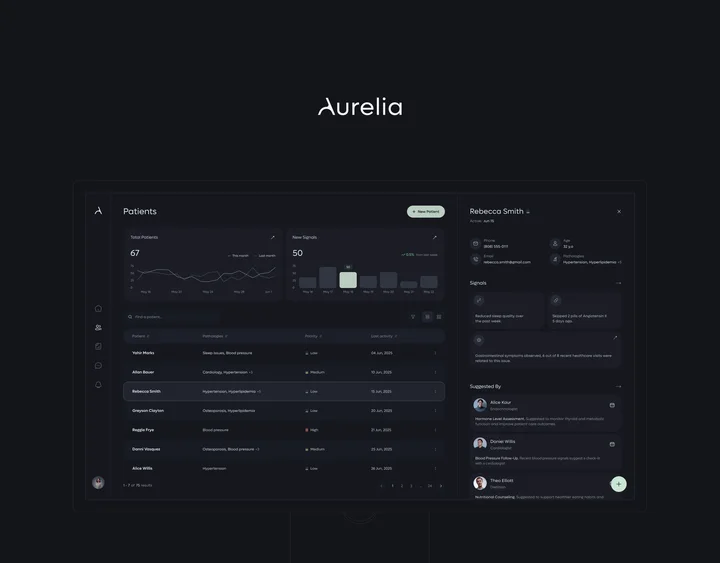
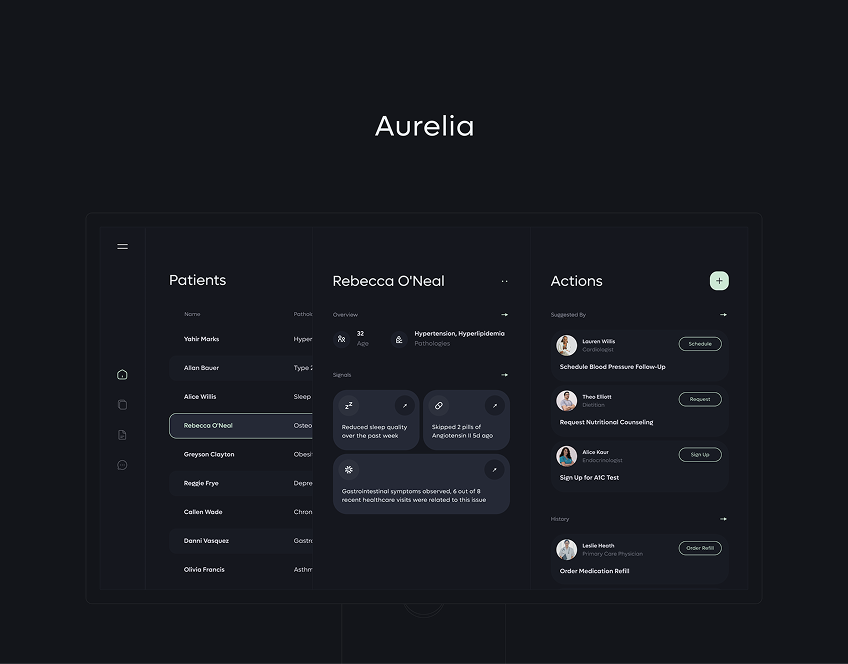
Aurelia

A digital health dashboard that enables medical professionals to monitor patient populations, track clinical signals, and coordinate multidisciplinary care within a unified interface.

HealthTech Dashboard Design UX audit Product redesign
Aurelia dashboard before the redesign
Aurelia dashboard after the redesign

WHEN NOT TO REDESIGN

IV.

Sometimes a redesign
isn’t the answer

Not every struggling product needs
a redesign.
We’ll tell you honestly
in the initial consultation
which path
makes sense.

Consulting

If your core product-market fit

is unvalidated, a redesign won’t fix it —

you need product discovery first.

Website design

If your product works well but your

marketing site doesn’t convert,

you need a website redesign,

not a product redesign.

UX audit

If you have isolated friction points
but
the overall experience is sound,
a UX audit
with targeted fixes is faster
and a smaller
commitment.

FAQ

V.

Common questions

Redesign when the problems are structural, not cosmetic — when navigation has
deepened past usability, workflows that worked at 100 users break at 10,000,
support tickets cluster around the same friction, and each new feature fights
the existing UX instead of composing with it. If the issues are isolated, a targeted UX
audit with fixes is faster and costs less to run. If product-market fit itself
is unproven, you need discovery first, not a redesign. The signal for a full redesign
is accumulated UX debt across the core experience, not a few rough edges.

Redesign when the problems are structural, not cosmetic — when navigation has deepened past
usability, workflows that worked at 100 users break at 10,000, support tickets cluster around
the same friction, and each new feature fights the existing UX instead of composing with it.
If the issues are isolated, a targeted UX audit with fixes is faster and costs less to run. If product-
market fit itself is unproven, you need discovery first, not a redesign. The signal for a full redesign
is accumulated UX debt across the core experience, not a few rough edges.

Yes — that’s how most engagements are designed to start. The Product Audit is a scoped
diagnostic from $8,000 and from two weeks: we examine your core flows, your funnel data,
and your accessibility posture, then hand you a prioritized roadmap you could execute without us
and walk your team through it. At that stage you’re buying knowledge about your product,
not design work. The findings are yours regardless — nobody commits to a redesign on day one.

Redesign when the problems are structural,
not cosmetic — when navigation
has deepened past usability, workflows
that worked at 100 users break at 10,000,
support tickets cluster around the same
friction, and each new feature fights
the existing UX instead of composing with it.
If the issues are isolated, a targeted UX audit
with fixes is faster and costs less to run.
If product-market fit itself is unproven, you
need discovery first, not a redesign. The signal
for a full redesign is accumulated UX debt
across the core experience, not a few rough
edges.

A UX audit diagnoses — it identifies what’s broken and ranks it by impact.
A redesign treats — it rebuilds the flows, patterns, and visual system to fix what
the audit found. They’re sequential, not alternatives: the audit becomes
the redesign brief, so the work targets real friction rather than assumptions. Many
of our redesigns start as an audit; the audit’s baseline is also what we measure
the redesign against afterward. → /ux-audit

A UX audit diagnoses — it identifies what’s broken and ranks it by impact. A redesign treats —
it rebuilds the flows, patterns, and visual system to fix what the audit found. They’re sequential,
not alternatives: the audit becomes the redesign brief, so the work targets real friction rather than
assumptions. Many of our redesigns start as an audit; the audit’s baseline is also what we measure
the redesign against afterward. → /ux-audit

Closely, and on their terms. A single design lead joins your existing cadence — sprints, standups,
whatever you run — and every decision is documented with its rationale, so engineers aren’t
reverse-engineering intent from mockups. We check feasibility early, hand off in the formats your
team builds from, and treat “it shipped as designed” as the definition of done.
Where an engagement includes front-end delivery — design systems, production components —
we build alongside your team; otherwise we make sure what we design gets built.

A UX audit diagnoses — it identifies what’s
broken and ranks it by impact. A redesign
treats — it rebuilds the flows, patterns,
and visual system to fix what the audit found.
They’re sequential, not alternatives: the audit
becomes the redesign brief, so the work
targets real friction rather than assumptions.
Many of our redesigns start as an audit;
the audit’s baseline is also what we measure
the redesign against afterward. → /ux-audit

Phased rollout. We don’t ship a jarring overnight change; we prioritize by impact —
highest-friction flows first, then secondary flows, then polish — and each phase
is independently usable and shippable. Users experience gradual improvement
rather than a relearning cliff. We also build the design system first, so every
redesigned surface draws from one coherent language instead of fragmenting again
as new work ships. → /design-systems

Phased rollout. We don’t ship a jarring overnight change; we prioritize by impact — highest-friction
flows first, then secondary flows, then polish — and each phase is independently usable
and shippable. Users experience gradual improvement rather than a relearning cliff. We also build
the design system first, so every redesigned surface draws from one coherent language instead
of fragmenting again as new work ships. → /design-systems

It depends on the entry point. The Product Audit starts at two weeks and scales with the size
of the product. A modernization or end-to-end design engagement typically runs eight to twelve
weeks in phases — architecture first, then flows, then system and handoff — with the first
reviewable work inside two weeks. Operations engagements run on a monthly cadence with
a quarterly review. You get a dated plan and a price before anything is signed, and we keep to it:
predictability is part of the product.

Phased rollout. We don’t ship a jarring
overnight change; we prioritize by impact —
highest-friction flows first, then secondary
flows, then polish — and each phase
is independently usable and shippable. Users
experience gradual improvement rather than
a relearning cliff. We also build the design
system first, so every redesigned surface
draws from one coherent language instead
of fragmenting again as new work ships.
→ /design-systems

Against the baseline captured in the initial audit. Before redesigning, we record
the metrics that matter — activation, churn, task completion, support volume —
then measure each redesigned flow against that starting point. If a change doesn’t
move the metric it was meant to, we iterate. That measurement loop is what
separates a redesign from a reskin: the goal is a quantified improvement in how
the product performs, not how it looks.

Against the baseline captured in the initial audit. Before redesigning, we record the metrics
that matter — activation, churn, task completion, support volume — then measure each redesigned
flow against that starting point. If a change doesn’t move the metric it was meant to, we iterate.
That measurement loop is what separates a redesign from a reskin: the goal is a quantified
improvement in how the product performs, not how it looks.

Our deepest experience is in SaaS — fintech platforms, healthtech products, enterprise tools,
cybersecurity operations, and proptech systems. But the skill set transfers: if your product
is data-dense, regulated, or operationally complex, the design problems are the same regardless
of the business model. If you’re unsure about fit, ask — we’ll tell you honestly, including when
the answer is no.

Against the baseline captured in the initial
audit. Before redesigning, we record the
metrics that matter — activation, churn, task
completion, support volume — then measure
each redesigned flow against that starting
point. If a change doesn’t move the metric
it was meant to, we iterate. That measurement
loop is what separates a redesign from
a reskin: the goal is a quantified improvement
in how the product performs, not how it looks.

We baseline before we design. Every engagement starts by capturing the current
numbers — activation, conversion, task success, error rates, time-to-value, support
volume — and agreeing which of them the work should move. After launch we
measure again at 30, 60, and 90 days and report the delta the same way we
publish case studies: baseline → result. If your analytics can’t answer the question
yet, instrumenting them is the first task. We call the arc Baseline → Move → Prove —
and we’re honest about attribution: design shares outcomes with product,
engineering, and market timing, so we tell you what design moved and what it didn’t.

We baseline before we design. Every engagement starts
by capturing the current numbers — activation, conversion, task
success, error rates, time-to-value, support volume — and
agreeing which of them the work should move. After launch we
measure again at 30, 60, and 90 days and report the delta
the same way we publish case studies: baseline → result. If your
analytics can’t answer the question yet, instrumenting them
is the first task. We call the arc Baseline → Move → Prove —
and we’re honest about attribution: design shares outcomes
with product, engineering, and market timing, so we tell you
what design moved and what it didn’t.

We baseline before we design. Every engagement starts by capturing the current numbers —
activation, conversion, task success, error rates, time-to-value, support volume — and agreeing
which of them the work should move. After launch we measure again at 30, 60, and 90 days and
report the delta the same way we publish case studies: baseline → result. If your analytics can’t
answer the question yet, instrumenting them is the first task. We call the arc Baseline → Move →
Prove — and we’re honest about attribution: design shares outcomes with product, engineering,
and market timing, so we tell you what design moved and what it didn’t.

We baseline before we design. Every
engagement starts by capturing the current
numbers — activation, conversion, task
success, error rates, time-to-value, support
volume — and agreeing which of them
the work should move. After launch we
measure again at 30, 60, and 90 days
and report the delta the same way we publish
case studies: baseline → result. If your
analytics can’t answer the question yet,
instrumenting them is the first task. We call
the arc Baseline → Move → Prove — and we’re
honest about attribution: design shares
outcomes with product, engineering,
and market timing, so we tell you what design
moved and what it didn’t.

That’s more common than not having one. A design system that isn’t working
is usually a governance problem, not a component problem — unclear ownership,
no contribution model, drift between code and design. We audit how the system
is actually used, then fix the operating model around it: decision rights, contribution
workflow, release cadence, documentation engineers accept. Sometimes
the answer is consolidating what you have rather than rebuilding — that’s a cheaper
answer, and we give it when it’s true. For teams preparing for AI tooling (Code
Connect, MCP, DTCG tokens), we assess AI-readiness specifically.

That’s more common than not having one. A design system that
isn’t working is usually a governance problem, not a component
problem — unclear ownership, no contribution model, drift
between code and design. We audit how the system is actually
used, then fix the operating model around it: decision rights,
contribution workflow, release cadence, documentation
engineers accept. Sometimes the answer is consolidating what
you have rather than rebuilding — that’s a cheaper answer, and
we give it when it’s true. For teams preparing for AI tooling
(Code Connect, MCP, DTCG tokens), we assess AI-readiness
specifically.

That’s more common than not having one. A design system that isn’t working is usually
a governance problem, not a component problem — unclear ownership, no contribution model,
drift between code and design. We audit how the system is actually used, then fix the operating
model around it: decision rights, contribution workflow, release cadence, documentation engineers
accept. Sometimes the answer is consolidating what you have rather than rebuilding — that’s
a cheaper answer, and we give it when it’s true. For teams preparing for AI tooling (Code Connect,
MCP, DTCG tokens), we assess AI-readiness specifically.

That’s more common than not having one.
A design system that isn’t working is usually
a governance problem, not a component
problem — unclear ownership, no contribution
model, drift between code and design. We
audit how the system is actually used, then fix
the operating model around it: decision rights,
contribution workflow, release cadence,
documentation engineers accept. Sometimes
the answer is consolidating what you have
rather than rebuilding — that’s a cheaper
answer, and we give it when it’s true.
For teams preparing for AI tooling (Code
Connect, MCP, DTCG tokens), we assess
AI-readiness specifically.

How SaaS companies redesign their products?

READ ARTICLE

Your product
has changed.
Your UX should too.

DISCUSS A REDESIGN