A SaaS design system, built for handoff
Component library, tokens, documentation, governance — the four parts
that decide whether design system development survives its first year.

Design system agency
Design systems for SaaS teams scaling from
5 to 50 engineers.
Components, tokens,
documentation, and the governance model
that keeps them in sync.
WHY IT MATTERS
i.
Early-stage SaaS products ship fast.
Screens get
designed in isolation.
Buttons have three sizes.
Modals behave
differently across flows. Loading
states
are inconsistent. Each inconsistency
is minor on its own. Collectively, they erode
user
trust and slow engineering velocity —
every new
feature requires one-off
decisions instead
of composing from
existing, tested patterns.
A design system establishes the shared
vocabulary:
components, tokens, patterns,
and rules
that ensure coherence across your
product
as the team grows. It’s not a library —
it’s an operating agreement between
design
and engineering.
WHAT WE DELIVER
II.
Component library, tokens, documentation, governance — the four parts
that decide whether design system development survives its first year.
Production-ready components in Figma
with matching code components
(React, Vue,
or your framework). Buttons, forms, modals,
tables,
navigation,
data visualization
primitives — everything your engineering
team needs to ship
without waiting
for design.
Production-ready components in Figma with matching code components
(React, Vue, or your framework). Buttons, forms, modals, tables,
navigation, data visualization primitives — everything your engineering
team needs to ship without waiting for design.
Colors, typography scales, spacing,
elevation, border radii — defined
as platform-agnostic tokens that propagate
across web, mobile, and email.
Change
a token once, update every surface
automatically.
Usage guidelines, do/don’t examples,
accessibility annotations, interaction
specs,
and code snippets. The documentation
makes the system
self-serve —
a new engineer on day one can build
a compliant interface
without asking
anyone.
Usage guidelines, do/don’t examples, accessibility annotations, interaction
specs, and code snippets. The documentation makes the system
self-serve — a new engineer on day one can build a compliant interface
without asking anyone.
Contribution guidelines, versioning strategy
(we recommend semantic
versioning),
breaking change policy, deprecation
process, and design
review
cadence.
Without governance, a design system
degrades into
a component
dump within
6 months. We’ve seen it happen.
OUR PROCESS
III.
We inventory every existing component,
pattern,
and
inconsistency
across your
product. Most teams
are surprised by
the scope —
40-component
products
routinely have 120+ distinct UI patterns
when you count variants.
We define the token structure, component
hierarchy,
and naming
conventions.
This is the phase
that determines
whether
the system
scales cleanly
or accumulates debt.
We design and document components
in priority
order —
starting with
the primitives used on every
screen (typography,
spacing, buttons, forms),
then build the accessibility remediation
roadmap
and VPAT documentation.
We build
up to composed
patterns (card
layouts, data tables, navigation).
We work with your engineering team to align
Figma
components
with code components.
Token values
are synced.
Naming conventions match. The handoff
isn’t a handoff —
it’s a shared system.
We establish the review process,
contribution
guidelines,
and versioning
cadence. Then we either
hand over
governance
to your team or continue
managing it through a design retainer.
SYSTEMS FOR REDESIGNS
IV.
If you’re considering a product redesign,
the design
system should come first —
not after.
It establishes
the visual and
interaction
language
that
the redesigned
product will use.
Without it,
a redesign
is a one-time cosmetic
update that
fragments again within a year as new
features
ship
outside the system. We’ve built
design
systems
both as standalone
engagements
and as
the first
phase of larger
product
modernization
projects.
AI-READY ARCHITECTURE
V.
Most design systems are built for human
designers:
they live in Figma, documented
in a wiki, and
translated into code manually.
The result is drift —
tokens diverge,
components
don’t match, and AI
coding
tools hallucinate
plausible-looking UI that
doesn’t match anything
in the system.
We build design systems
that machines
can
consume directly:
Your color, spacing, and typography tokens
in
a JSON format that
feeds Figma,
Style Dictionary,
CSS custom properties, Tailwind config,
and AI
coding assistants
from a single canonical source.
One file,
every consumer.
Every Figma component links to its
code
implementation — so when an AI tool asks
“what component handles a sortable data table?”,
it gets the correct component,
its prop interface,
and the right token values. No visual translation,
no hallucination.
An AI design system is only as good as
its
maintenance cadence. Our governance
retainer
ensures new components follow
the template
(Figma + code + DTCG tokens +
Code Connect link +
usage docs),
existing components stay in sync, and
the system
evolves
as both the product and the AI
tooling change.
Figma’s MCP server and Code Connect
(April 2026)
mean design
systems can now
feed
directly into
AI coding workflows — but only
if
the token
architecture
and component-code
parity are right.
The system
is the moat:
it’s the difference
between AI that generates
chaos and AI
that generates
production-ready
front-end.
See this in practice
THE DESIGN SYSTEM AUDIT
VI.
The same Product Audit, scoped
to the layer
that
decides whether
AI tooling
helps you or floods
you
with
plausible-looking components.
FROM [2] WEEKS
Token architecture against the DTCG
standard.
Component-to-code
parity —
whether what designers ship and what
engineers build
are the same thing. Whether
Code Connect and
MCP mappings
exist
and
are accurate enough for an AI coding tool
to consume.
Documentation and
governance: who decides, who maintains,
what happens when the product moves
faster than the system.
Token architecture against the DTCG standard.
Component-to-code parity — whether what
designers ship and what engineers build are the same
thing. Whether Code Connect and MCP mappings
exist and are accurate enough for an AI coding tool
to consume. Documentation and governance: who
decides, who maintains, what happens when
the product moves faster than the system.
A readiness verdict with the gaps ranked
by what
they cost you,
an architecture
recommendation,
and
a written baseline —
coverage, parity, adoption —
so the next
phase can be measured
against something.
If your system is already sound, the report
will say
so and tell you where
to spend instead.
Not sure your tokens and components are AI-ready?
FAQ
VII.
The initial system (core primitives + 30-40 components + documentation +
governance model) typically takes from 8–12 weeks. But a design system is never
“done” — it evolves with your product. Ongoing governance is essential.
The initial system (core primitives + 30-40 components +
documentation + governance model) typically takes from 8–12
weeks. But a design system is never “done” — it evolves
with your product. Ongoing governance is essential.
The initial system (core primitives + 30-40 components + documentation + governance model)
typically takes from 8–12 weeks. But a design system is never “done” — it evolves with your
product. Ongoing governance is essential.
The initial system (core primitives + 30-40
components + documentation + governance
model) typically takes from 8–12 weeks. But
a design system is never “done” — it evolves
with your product. Ongoing governance
is essential.
A component library is one part of a design system. If your library lacks tokens,
documentation, governance, or a contribution model, it's a collection of parts —
not a system. We can audit what you have and build the missing layers.
A component library is one part of a design system. If your
library lacks tokens, documentation, governance, or
a contribution model, it's a collection of parts — not a system.
We can audit what you have and build the missing layers.
A component library is one part of a design system. If your library lacks tokens, documentation,
governance, or a contribution model, it's a collection of parts — not a system. We can audit
what you have and build the missing layers.
A component library is one part of a design
system. If your library lacks tokens,
documentation, governance, or a contribution
model, it's a collection of parts — not
a system. We can audit what you have
and build the missing layers.
It depends on your differentiation needs. Enterprise B2B products often start
with an existing framework and customize heavily. Consumer-facing SaaS typically
needs custom systems. We'll recommend based on your product, team size,
and timeline.
It depends on your differentiation needs. Enterprise B2B
products often start with an existing framework and customize
heavily. Consumer-facing SaaS typically needs custom systems.
We'll recommend based on your product, team size, and timeline.
It depends on your differentiation needs. Enterprise B2B products often start with an existing
framework and customize heavily. Consumer-facing SaaS typically needs custom systems.
We'll recommend based on your product, team size, and timeline.
It depends on your differentiation needs.
Enterprise B2B products often start with
an existing framework and customize heavily.
Consumer-facing SaaS typically needs
custom systems. We'll recommend based on
your product, team size, and timeline.
We design framework-agnostic systems in Figma. For code components, we work
with React, Vue, Angular, and web components. We align with whatever your
engineering team uses.
We design framework-agnostic systems in Figma. For code
components, we work with React, Vue, Angular, and web
components. We align with whatever your engineering team
uses.
We design framework-agnostic systems in Figma. For code components, we work with React, Vue,
Angular, and web components. We align with whatever your engineering team uses.
We design framework-agnostic systems
in Figma. For code components, we work
with React, Vue, Angular, and web
components. We align with whatever your
engineering team uses.
Yes. Design system rescue is a common engagement — usually triggered by low
adoption, inconsistent implementation, or governance collapse. We audit,
restructure, and re-launch.
Yes. Design system rescue is a common engagement — usually
triggered by low adoption, inconsistent implementation,
or governance collapse. We audit, restructure, and re-launch.
Yes. Design system rescue is a common engagement — usually triggered by low adoption,
inconsistent implementation, or governance collapse. We audit, restructure, and re-launch.
Yes. Design system rescue is a common
engagement — usually triggered by low
adoption, inconsistent implementation,
or governance collapse. We audit, restructure,
and re-launch.
That's more common than not having one. A design system that isn't working
is usually a governance problem, not a component problem — unclear ownership,
no contribution model, drift between code and design. We audit how the system
is actually used, then fix the operating model around it: decision rights, contribution
workflow, release cadence, documentation engineers accept. Sometimes
the answer is consolidating what you have rather than rebuilding — that's a cheaper
answer, and we give it when it's true. For teams preparing for AI tooling (Code
Connect, MCP, DTCG tokens), we assess AI-readiness specifically.
That's more common than not having one. A design system that
isn't working is usually a governance problem, not a component
problem — unclear ownership, no contribution model, drift
between code and design. We audit how the system is actually
used, then fix the operating model around it: decision rights,
contribution workflow, release cadence, documentation
engineers accept. Sometimes the answer is consolidating what
you have rather than rebuilding — that's a cheaper answer, and
we give it when it's true. For teams preparing for AI tooling
(Code Connect, MCP, DTCG tokens), we assess AI-readiness
specifically.
That's more common than not having one. A design system that isn't working is usually
a governance problem, not a component problem — unclear ownership, no contribution model,
drift between code and design. We audit how the system is actually used, then fix the operating
model around it: decision rights, contribution workflow, release cadence, documentation engineers
accept. Sometimes the answer is consolidating what you have rather than rebuilding — that's
a cheaper answer, and we give it when it's true. For teams preparing for AI tooling (Code Connect,
MCP, DTCG tokens), we assess AI-readiness specifically.
That's more common than not having one.
A design system that isn't working is usually
a governance problem, not a component
problem — unclear ownership, no contribution
model, drift between code and design. We
audit how the system is actually used, then fix
the operating model around it: decision rights,
contribution workflow, release cadence,
documentation engineers accept. Sometimes
the answer is consolidating what you have
rather than rebuilding — that's a cheaper
answer, and we give it when it's true.
For teams preparing for AI tooling (Code
Connect, MCP, DTCG tokens), we assess
AI-readiness specifically.
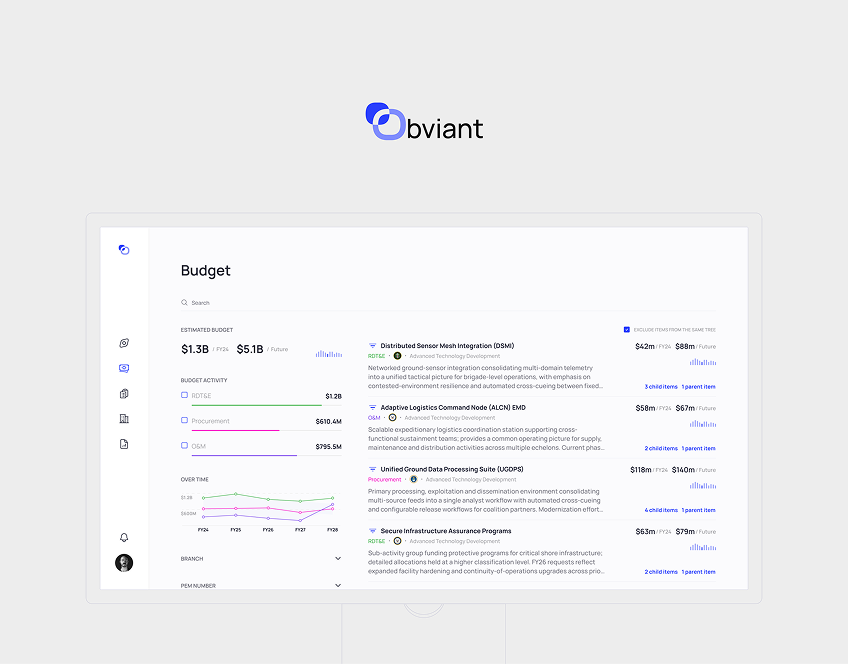
Government contracting platform redesign. Four federal datasets — budget, contract, program, organization — unified into one searchable interface for capture managers and BD teams.
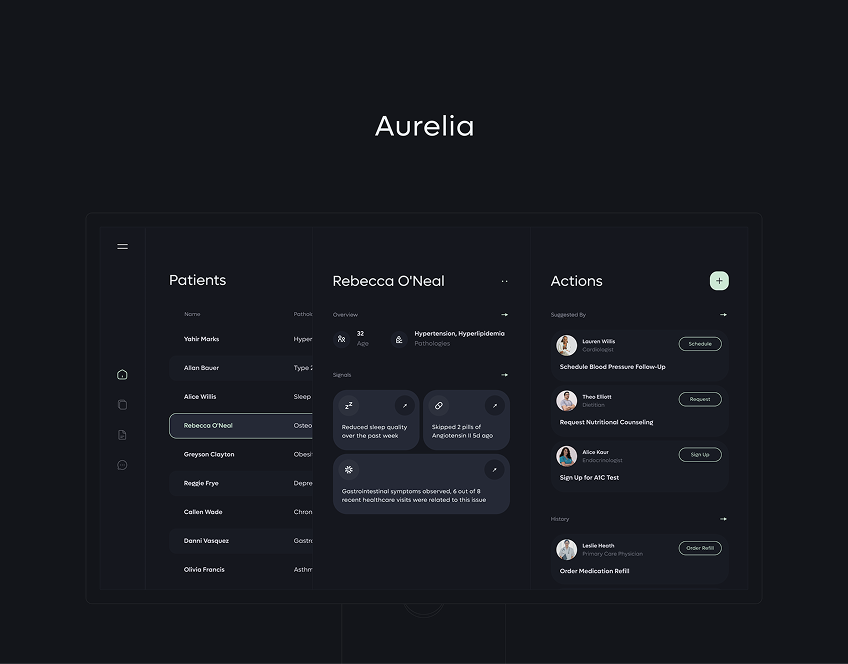
Full redesign of a dual-platform healthcare product for patients and providers. Patient onboarding completion: 24.6% → 43.9%. Provider core task: 11 → 5 steps. CSAT: 3.2 → 4.4/5.

EU accessibility audit for a workforce time-registration terminal. 210 WCAG criteria evaluated against three standards, severity-ranked, delivered as VPAT 2.5.
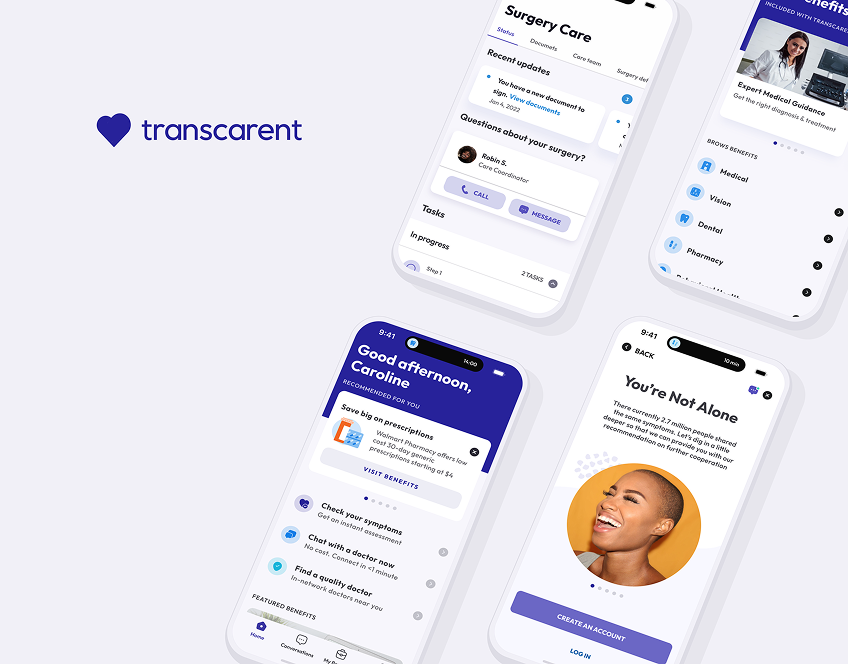
A consumer healthcare app integrating virtual care, providers, and local facilities, with a medicine-matching system. Result: 4.7 App Store rating, 24% saved by members on substitute medicines.