
UX consultant
From zero
to validated concept —
starting at two weeks
Strategic UI/UX consulting for SaaS teams. A senior
consultant on the problem —
design strategy,
product discovery, and the roadmap that follows.
START HERE
i.
Who this page is for
For new products, validation work,
or strategic UX
direction before
committing engineering resources.
If you’re scoping a build,
deciding what
to build next,
or want an expert opinion
before
a redesign —
this is the right page.
WHEN TO ENGAGE
ii.
When should you hire
a UX consultant?
Hire a UX consultant when you need
strategic
design direction before
committing engineering
resources —
not a full design team to execute.
The clearest signals: you’ve validated
the problem
and have early traction or seed
funding,
your
engineers can build but no one
can
design,
or you
have a product that’s
outgrown its
original UX
and you want
an outside read before
a redesign.
In each
case you need a consultant
who
understands SaaS specifically —
not
a generalist
who’ll propose solutions that
ignore your technical
constraints, regulatory
environment,
or go-to-market timeline.
That is the core of our SaaS consulting
practice:
strategy that survives contact
with your
codebase.
Not every product
needs a full design
team.
Some need
strategic direction first.
HOW WE WORK
iii.
SaaS consulting services
in three formats.
Choose what fits.
For teams starting from zero. We define
your target
user,
map the competitive
landscape, identify
the core value
proposition,
and produce
a UX strategy
document with wireframes
for the critical
user flows.
You leave with a clear
design
direction your
engineering
team can
build against.
FROM [1-2] WEEKS
For teams with a specific problem to solve.
We take
one critical
challenge —
onboarding flow, pricing
page,
dashboard
redesign —
and produce a tested
prototype in five days.
Based on
the Google
Ventures
sprint methodology,
adapted for SaaS.
FROM [5] DAYS
For teams with an existing product that
needs
expert
evaluation
before major
investment.
We assess your
product’s UX
maturity,
benchmark
against
competitors,
and deliver a strategic
roadmap
with prioritized initiatives.
FROM [2-3] WEEKS
WHAT YOU GET
iv.
Deliverables,
not decks
Every engagement produces tangible
artifacts
your
team can act on. UX strategy
document
with user
flows and information
architecture.
Wireframes
or
high-fidelity
prototypes
(depending
on engagement
type).
Competitive analysis with
benchmarking.
Design recommendations
prioritized
by impact
and effort. A clear
scope estimate if you
decide
to move into
full product design.
FAQ
V.
Common questions
Consulting is scoped by engagement type. A 5-day Design Sprint, a 1–2 week
Product Discovery Workshop, and a 2–3 week Strategic UX Review are each fixed-
scope formats — we agree on the scope and price in the kickoff call, not
by the hour. We work primarily with established SaaS companies and funded
founders where the engagement justifies a senior team.
Consulting is scoped by engagement type. A 5-day Design
Sprint, a 1–2 week Product Discovery Workshop, and a 2–3
week Strategic UX Review are each fixed-scope formats —
we agree on the scope and price in the kickoff call, not
by the hour. We work primarily with established SaaS
companies and funded founders where the engagement
justifies a senior team.
Consulting is scoped by engagement type. A 5-day Design Sprint, a 1–2 week Product Discovery
Workshop, and a 2–3 week Strategic UX Review are each fixed-scope formats — we agree
on the scope and price in the kickoff call, not by the hour. We work primarily with established SaaS
companies and funded founders where the engagement justifies a senior team.
Consulting is scoped by engagement type.
A 5-day Design Sprint, a 1–2 week
Product Discovery Workshop, and a 2–3 week
Strategic UX Review are each fixed-scope
formats — we agree on the scope and price
in the kickoff call, not by the hour. We work
primarily with established SaaS companies
and funded founders where the engagement
justifies a senior team.
Consulting produces strategy and direction. A full engagement produces
the designed product. Many clients start with a discovery workshop, then move
into product design. The workshop output becomes the project brief.
Consulting produces strategy and direction. A full engagement
produces the designed product. Many clients start
with a discovery workshop, then move into product design.
The workshop output becomes the project brief.
Consulting produces strategy and direction. A full engagement produces the designed product.
Many clients start with a discovery workshop, then move into product design. The workshop
output becomes the project brief.
Consulting produces strategy and direction.
A full engagement produces the designed
product. Many clients start with a discovery
workshop, then move into product design.
The workshop output becomes the project
brief.
Yes. Some of our best work has been with pre-seed and seed-stage founders
who needed to go from idea to investor-ready prototype. The discovery format
is designed for early-stage teams.
Yes. Some of our best work has been with pre-seed and seed-
stage founders who needed to go from idea to investor-ready
prototype. The discovery format is designed for early-stage
teams.
Yes. Some of our best work has been with pre-seed and seed-stage founders who needed to
go from idea to investor-ready prototype. The discovery format is designed for early-stage teams.
Yes. Some of our best work has been with
pre-seed and seed-stage founders who
needed to go from idea to investor-ready
prototype. The discovery format is designed
for early-stage teams.
Absolutely. We often operate as a strategic layer — defining direction, creating
the design system foundation — while your internal team handles implementation
and iteration.
Absolutely. We often operate as a strategic layer — defining
direction, creating the design system foundation — while your
internal team handles implementation and iteration.
Absolutely. We often operate as a strategic layer — defining direction, creating the design system
foundation — while your internal team handles implementation and iteration.
Absolutely. We often operate as a strategic
layer — defining direction, creating
the design system foundation — while your
internal team handles implementation
and iteration.
We baseline before we design. Every engagement starts by capturing the current
numbers — activation, conversion, task success, error rates, time-to-value, support
volume — and agreeing which of them the work should move. After launch we
measure again at 30, 60, and 90 days and report the delta the same way we
publish case studies: baseline → result. If your analytics can’t answer the question
yet, instrumenting them is the first task. We call the arc Baseline → Move → Prove —
and we’re honest about attribution: design shares outcomes with product,
engineering, and market timing, so we tell you what design moved and what it didn’t.
We baseline before we design. Every engagement starts
by capturing the current numbers — activation, conversion, task
success, error rates, time-to-value, support volume — and
agreeing which of them the work should move. After launch we
measure again at 30, 60, and 90 days and report the delta
the same way we publish case studies: baseline → result. If your
analytics can’t answer the question yet, instrumenting them
is the first task. We call the arc Baseline → Move → Prove —
and we’re honest about attribution: design shares outcomes
with product, engineering, and market timing, so we tell you
what design moved and what it didn’t.
We baseline before we design. Every engagement starts by capturing the current numbers —
activation, conversion, task success, error rates, time-to-value, support volume — and agreeing
which of them the work should move. After launch we measure again at 30, 60, and 90 days and
report the delta the same way we publish case studies: baseline → result. If your analytics can’t
answer the question yet, instrumenting them is the first task. We call the arc Baseline → Move →
Prove — and we’re honest about attribution: design shares outcomes with product, engineering,
and market timing, so we tell you what design moved and what it didn’t.
We baseline before we design. Every
engagement starts by capturing the current
numbers — activation, conversion, task
success, error rates, time-to-value, support
volume — and agreeing which of them
the work should move. After launch we
measure again at 30, 60, and 90 days
and report the delta the same way we publish
case studies: baseline → result. If your
analytics can’t answer the question yet,
instrumenting them is the first task. We call
the arc Baseline → Move → Prove — and we’re
honest about attribution: design shares
outcomes with product, engineering,
and market timing, so we tell you what design
moved and what it didn’t.
That’s more common than not having one. A design system that isn’t working
is usually a governance problem, not a component problem — unclear ownership,
no contribution model, drift between code and design. We audit how the system
is actually used, then fix the operating model around it: decision rights, contribution
workflow, release cadence, documentation engineers accept. Sometimes
the answer is consolidating what you have rather than rebuilding — that’s a cheaper
answer, and we give it when it’s true. For teams preparing for AI tooling (Code
Connect, MCP, DTCG tokens), we assess AI-readiness specifically.
That’s more common than not having one. A design system that
isn’t working is usually a governance problem, not a component
problem — unclear ownership, no contribution model, drift
between code and design. We audit how the system is actually
used, then fix the operating model around it: decision rights,
contribution workflow, release cadence, documentation
engineers accept. Sometimes the answer is consolidating what
you have rather than rebuilding — that’s a cheaper answer, and
we give it when it’s true. For teams preparing for AI tooling
(Code Connect, MCP, DTCG tokens), we assess AI-readiness
specifically.
That’s more common than not having one. A design system that isn’t working is usually
a governance problem, not a component problem — unclear ownership, no contribution model,
drift between code and design. We audit how the system is actually used, then fix the operating
model around it: decision rights, contribution workflow, release cadence, documentation engineers
accept. Sometimes the answer is consolidating what you have rather than rebuilding — that’s
a cheaper answer, and we give it when it’s true. For teams preparing for AI tooling (Code Connect,
MCP, DTCG tokens), we assess AI-readiness specifically.
That’s more common than not having one.
A design system that isn’t working is usually
a governance problem, not a component
problem — unclear ownership, no contribution
model, drift between code and design. We
audit how the system is actually used, then fix
the operating model around it: decision rights,
contribution workflow, release cadence,
documentation engineers accept. Sometimes
the answer is consolidating what you have
rather than rebuilding — that’s a cheaper
answer, and we give it when it’s true.
For teams preparing for AI tooling (Code
Connect, MCP, DTCG tokens), we assess
AI-readiness specifically.
Already have a product?
Our UX audit is designed for existing platforms.
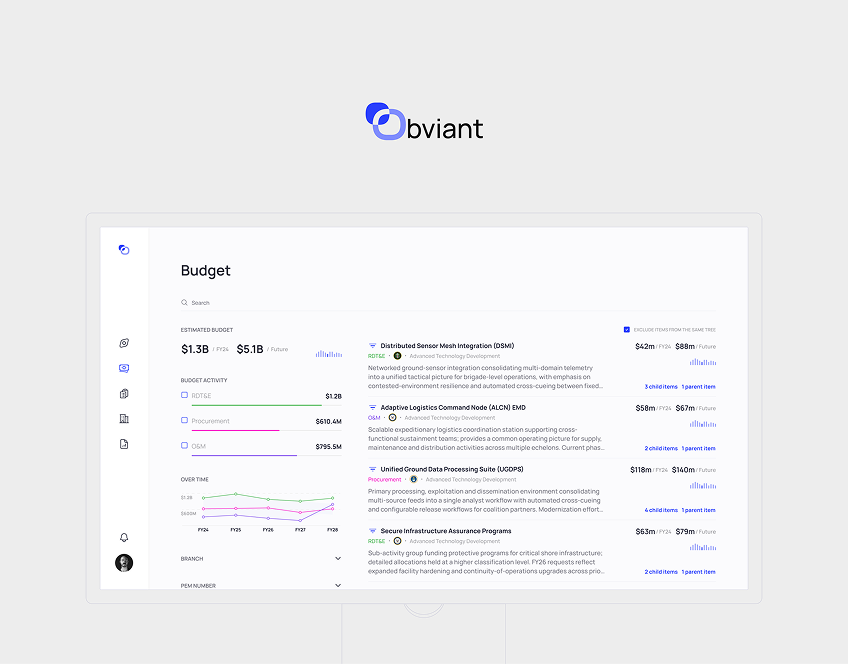
Obviant
Government contracting platform redesign. Four federal datasets — budget, contract, program, organization — unified into one searchable interface for capture managers and BD teams.
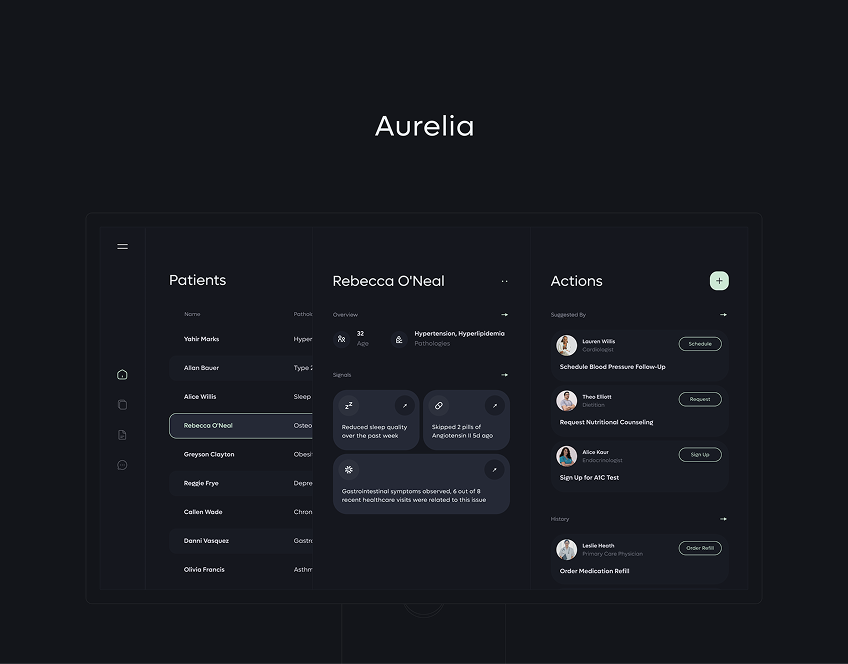
Aurelia
Full redesign of a dual-platform healthcare product for patients and providers. Patient onboarding completion: 24.6% → 43.9%. Provider core task: 11 → 5 steps. CSAT: 3.2 → 4.4/5.
SmartTID
EU accessibility audit for a workforce time-registration terminal. 210 WCAG criteria evaluated against three standards, severity-ranked, delivered as VPAT 2.5.
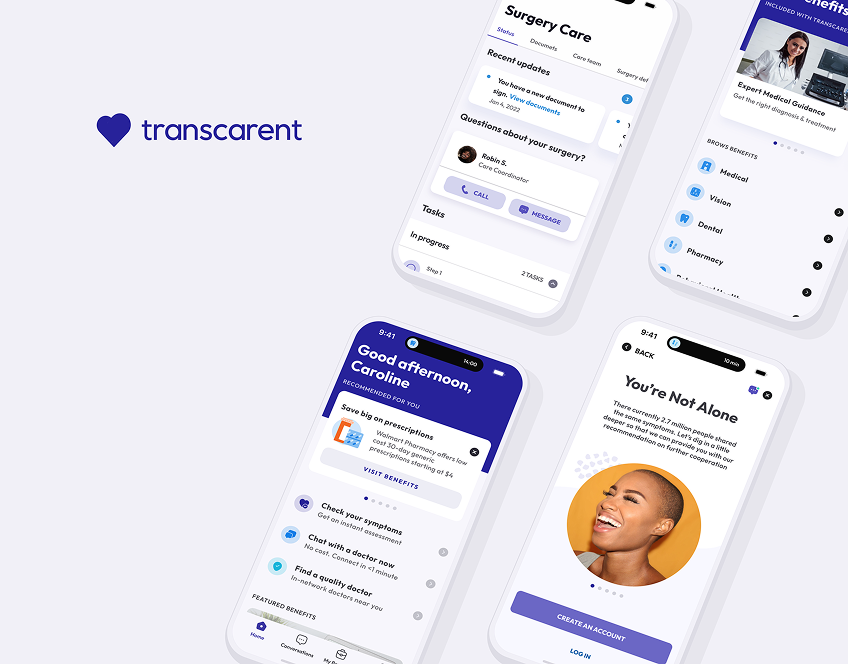
Transcarent
A consumer healthcare app integrating virtual care, providers, and local facilities, with a medicine-matching system. Result: 4.7 App Store rating, 24% saved by members on substitute medicines.