Dashboard & data visualization
Making complex data actionable. Real-time
analytics, drill-down
interfaces,
and data
tables that inform decisions.

SaaS product design
End-to-end product design — market research,
information architecture,
interaction systems,
and engineering handoff. One team,
one continuous process.
WHAT WE DO
I.
B2B SaaS design has layers that compound when you get them right. We handle every one of them.
Making complex data actionable. Real-time
analytics, drill-down
interfaces,
and data
tables that inform decisions.
Reducing the gap between signup and value.
Progressive disclosure,
contextual guidance,
and compliance-safe flows.
Designing trust for autonomous systems.
Approval gates, confidence
indicators,
and human-in-the-loop controls.
The architecture that keeps your product
coherent at scale.
Component
libraries,
tokens, documentation, and governance.
WCAG 2.2 AA, EAA, ADA. We design for
compliance from the start,
not as a retrofit.
WHERE WE WORK
II.
We design for industries where UX
requirements
are defined by regulations,
data complexity,
and high-stakes workflows.

FINTECH

HEALTHTECH

ENTERPRISE
CYBERSECURITY

PROPTECH
OUR PROCESS
III.
Stakeholder interviews, competitive analysis,
user
research,
information architecture.
We define
the product’s structure
before
designing
a single screen.
FROM [1-2] WEEKS
Wireframes, interaction design, visual design,
prototyping.
Iterative reviews with your team
at every stage.
No reveal-at-the-end surprises.
FROM [4-8] WEEKS
Design system documentation, component
specs,
and handoff-ready
assets in Figma.
Your engineers
get everything they need
to build
exactly
what was designed.
FROM [2-3] WEEKS
Need the marketing site as well as the product?
FAQ
IV.
SaaS product design is the end-to-end design of a software-as-a-service product
— not just its screens, but its structure, flows, and the system that holds them
together as the product grows. It spans market and user research, information
architecture, interaction and visual design, prototyping, and engineering handoff,
usually anchored by a design system so the product stays coherent as features
ship. Unlike one-off UI work, SaaS product design is built to scale: the same
engagement might start with one onboarding flow and grow into a re-architected
platform.
SaaS product design is the end-to-end design of a software-
as-a-service product — not just its screens, but its structure,
flows, and the system that holds them together as the product
grows. It spans market and user research, information
architecture, interaction and visual design, prototyping,
and engineering handoff, usually anchored by a design system
so the product stays coherent as features ship. Unlike one-off
UI work, SaaS product design is built to scale: the same
engagement might start with one onboarding flow and grow
into a re-architected platform.
SaaS product design is the end-to-end design of a software-as-a-service product — not just its
screens, but its structure, flows, and the system that holds them together as the product grows.
It spans market and user research, information architecture, interaction and visual design,
prototyping, and engineering handoff, usually anchored by a design system so the product stays
coherent as features ship. Unlike one-off UI work, SaaS product design is built to scale: the same
engagement might start with one onboarding flow and grow into a re-architected platform.
SaaS product design is the end-to-end design
of a software-as-a-service product — not just
its screens, but its structure, flows,
and the system that holds them together as
the product grows. It spans market and user
research, information architecture, interaction
and visual design, prototyping, and
engineering handoff, usually anchored by
a design system so the product stays
coherent as features ship. Unlike one-off UI
work, SaaS product design is built to scale:
the same engagement might start with one
onboarding flow and grow into
a re-architected platform.
A SaaS design agency designs the layers generalists skip: dashboards and data
visualization, onboarding and activation, design systems, agentic-AI interfaces,
and accessibility built in from the start. It works the way engineering teams work —
in systems, with documented decisions, against measurable product metrics like
activation and retention — and it understands domain constraints (KYC flows,
HIPAA, security operations) that a generalist would treat as afterthoughts.
The difference shows up most in regulated, data-dense products where a wrong
design decision has operational cost.
A SaaS design agency designs the layers generalists skip:
dashboards and data visualization, onboarding and activation,
design systems, agentic-AI interfaces, and accessibility built
in from the start. It works the way engineering teams work —
in systems, with documented decisions, against measurable
product metrics like activation and retention —
and it understands domain constraints (KYC flows, HIPAA,
security operations) that a generalist would treat
as afterthoughts. The difference shows up most in regulated,
data-dense products where a wrong design decision has
operational cost.
A SaaS design agency designs the layers generalists skip: dashboards and data visualization,
onboarding and activation, design systems, agentic-AI interfaces, and accessibility built in from
the start. It works the way engineering teams work — in systems, with documented decisions,
against measurable product metrics like activation and retention — and it understands domain
constraints (KYC flows, HIPAA, security operations) that a generalist would treat as afterthoughts.
The difference shows up most in regulated, data-dense products where a wrong design decision
has operational cost.
A SaaS design agency designs the layers
generalists skip: dashboards and data
visualization, onboarding and activation,
design systems, agentic-AI interfaces,
and accessibility built in from the start.
It works the way engineering teams work —
in systems, with documented decisions,
against measurable product metrics like
activation and retention — and it understands
domain constraints (KYC flows, HIPAA, security
operations) that a generalist would treat as
afterthoughts. The difference shows up most
in regulated, data-dense products where
a wrong design decision has operational cost.
Product design is scoped per engagement, not billed hourly. A focused piece
of work (a single flow or feature) is a smaller fixed scope; a full product design
engagement — discovery through systems and handoff — runs over a longer
phased timeline. We scope precisely after a discovery call, once we understand
your product’s complexity, integrations, and stage. We work primarily with
established SaaS companies and funded teams where the engagement justifies
a senior team.
Product design is scoped per engagement, not billed hourly.
A focused piece of work (a single flow or feature) is a smaller
fixed scope; a full product design engagement — discovery
through systems and handoff — runs over a longer phased
timeline. We scope precisely after a discovery call, once
we understand your product’s complexity, integrations,
and stage. We work primarily with established SaaS companies
and funded teams where the engagement justifies a senior
team.
Product design is scoped per engagement, not billed hourly. A focused piece of work (a single flow
or feature) is a smaller fixed scope; a full product design engagement — discovery through
systems and handoff — runs over a longer phased timeline. We scope precisely after a discovery
call, once we understand your product’s complexity, integrations, and stage. We work primarily with
established SaaS companies and funded teams where the engagement justifies a senior team.
Product design is scoped per engagement,
not billed hourly. A focused piece of work
(a single flow or feature) is a smaller fixed
scope; a full product design engagement —
discovery through systems and handoff —
runs over a longer phased timeline. We scope
precisely after a discovery call, once we
understand your product’s complexity,
integrations, and stage. We work primarily
with established SaaS companies and funded
teams where the engagement justifies a senior
team.
Yes — that’s the default. We design framework-aware components, document
decisions, and deliver handoff-ready assets in Figma that map to your stack (React,
Vue, or whatever your team uses). The handoff isn’t a wall-throw; we align design
and code so your engineers build exactly what was designed, and we can stay
involved through a design retainer if you want continuity. → /design-retainer
Yes — that’s the default. We design framework-aware
components, document decisions, and deliver handoff-ready
assets in Figma that map to your stack (React, Vue, or whatever
your team uses). The handoff isn’t a wall-throw; we align design
and code so your engineers build exactly what was designed,
and we can stay involved through a design retainer if you want
continuity. → /design-retainer
Yes — that’s the default. We design framework-aware components, document decisions,
and deliver handoff-ready assets in Figma that map to your stack (React, Vue, or whatever your
team uses). The handoff isn’t a wall-throw; we align design and code so your engineers build
exactly what was designed, and we can stay involved through a design retainer if you want
continuity. → /design-retainer
Yes — that’s the default. We design
framework-aware components, document
decisions, and deliver handoff-ready assets
in Figma that map to your stack (React, Vue,
or whatever your team uses). The handoff isn’t
a wall-throw; we align design and code so your
engineers build exactly what was designed,
and we can stay involved through a design
retainer if you want continuity. → /design-
retainer
We baseline before we design. Every engagement starts by capturing the current
numbers — activation, conversion, task success, error rates, time-to-value, support
volume — and agreeing which of them the work should move. After launch we
measure again at 30, 60, and 90 days and report the delta the same way we
publish case studies: baseline → result. If your analytics can’t answer the question
yet, instrumenting them is the first task. We call the arc Baseline → Move → Prove —
and we’re honest about attribution: design shares outcomes with product,
engineering, and market timing, so we tell you what design moved and what it didn’t.
We baseline before we design. Every engagement starts
by capturing the current numbers — activation, conversion, task
success, error rates, time-to-value, support volume — and
agreeing which of them the work should move. After launch we
measure again at 30, 60, and 90 days and report the delta
the same way we publish case studies: baseline → result. If your
analytics can’t answer the question yet, instrumenting them
is the first task. We call the arc Baseline → Move → Prove —
and we’re honest about attribution: design shares outcomes
with product, engineering, and market timing, so we tell you
what design moved and what it didn’t.
We baseline before we design. Every engagement starts by capturing the current numbers —
activation, conversion, task success, error rates, time-to-value, support volume — and agreeing
which of them the work should move. After launch we measure again at 30, 60, and 90 days and
report the delta the same way we publish case studies: baseline → result. If your analytics can’t
answer the question yet, instrumenting them is the first task. We call the arc Baseline → Move →
Prove — and we’re honest about attribution: design shares outcomes with product, engineering,
and market timing, so we tell you what design moved and what it didn’t.
We baseline before we design. Every
engagement starts by capturing the current
numbers — activation, conversion, task
success, error rates, time-to-value, support
volume — and agreeing which of them
the work should move. After launch we
measure again at 30, 60, and 90 days
and report the delta the same way we publish
case studies: baseline → result. If your
analytics can’t answer the question yet,
instrumenting them is the first task. We call
the arc Baseline → Move → Prove — and we’re
honest about attribution: design shares
outcomes with product, engineering,
and market timing, so we tell you what design
moved and what it didn’t.
That’s more common than not having one. A design system that isn’t working
is usually a governance problem, not a component problem — unclear ownership,
no contribution model, drift between code and design. We audit how the system
is actually used, then fix the operating model around it: decision rights, contribution
workflow, release cadence, documentation engineers accept. Sometimes
the answer is consolidating what you have rather than rebuilding — that’s a cheaper
answer, and we give it when it’s true. For teams preparing for AI tooling (Code
Connect, MCP, DTCG tokens), we assess AI-readiness specifically.
That’s more common than not having one. A design system that
isn’t working is usually a governance problem, not a component
problem — unclear ownership, no contribution model, drift
between code and design. We audit how the system is actually
used, then fix the operating model around it: decision rights,
contribution workflow, release cadence, documentation
engineers accept. Sometimes the answer is consolidating what
you have rather than rebuilding — that’s a cheaper answer, and
we give it when it’s true. For teams preparing for AI tooling
(Code Connect, MCP, DTCG tokens), we assess AI-readiness
specifically.
That’s more common than not having one. A design system that isn’t working is usually
a governance problem, not a component problem — unclear ownership, no contribution model,
drift between code and design. We audit how the system is actually used, then fix the operating
model around it: decision rights, contribution workflow, release cadence, documentation engineers
accept. Sometimes the answer is consolidating what you have rather than rebuilding — that’s
a cheaper answer, and we give it when it’s true. For teams preparing for AI tooling (Code Connect,
MCP, DTCG tokens), we assess AI-readiness specifically.
That’s more common than not having one.
A design system that isn’t working is usually
a governance problem, not a component
problem — unclear ownership, no contribution
model, drift between code and design. We
audit how the system is actually used, then fix
the operating model around it: decision rights,
contribution workflow, release cadence,
documentation engineers accept. Sometimes
the answer is consolidating what you have
rather than rebuilding — that’s a cheaper
answer, and we give it when it’s true.
For teams preparing for AI tooling (Code
Connect, MCP, DTCG tokens), we assess
AI-readiness specifically.
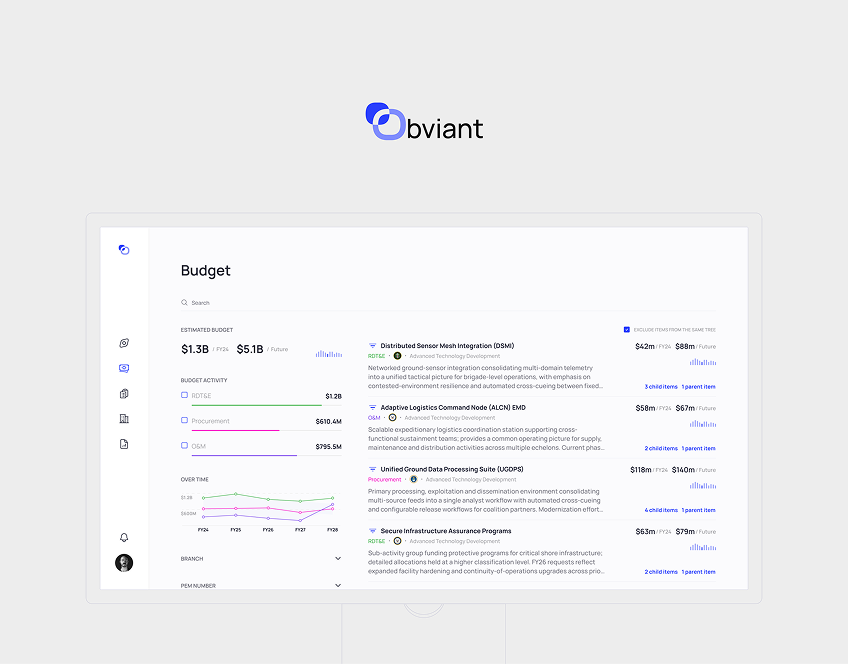
Government contracting platform redesign. Four federal datasets — budget, contract, program, organization — unified into one searchable interface for capture managers and BD teams.
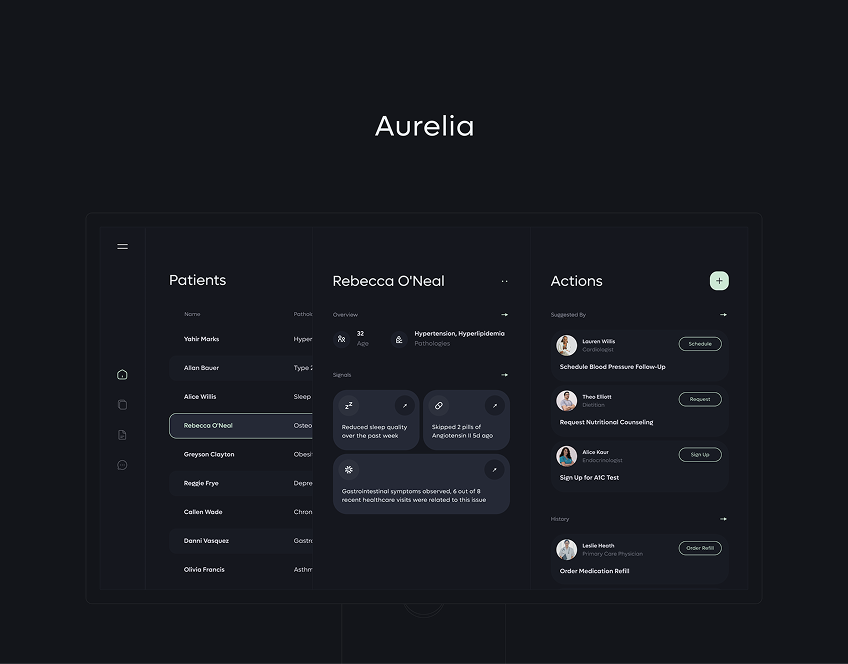
Full redesign of a dual-platform healthcare product for patients and providers. Patient onboarding completion: 24.6% → 43.9%. Provider core task: 11 → 5 steps. CSAT: 3.2 → 4.4/5.
EU accessibility audit for a workforce time-registration terminal. 210 WCAG criteria evaluated against three standards, severity-ranked, delivered as VPAT 2.5.
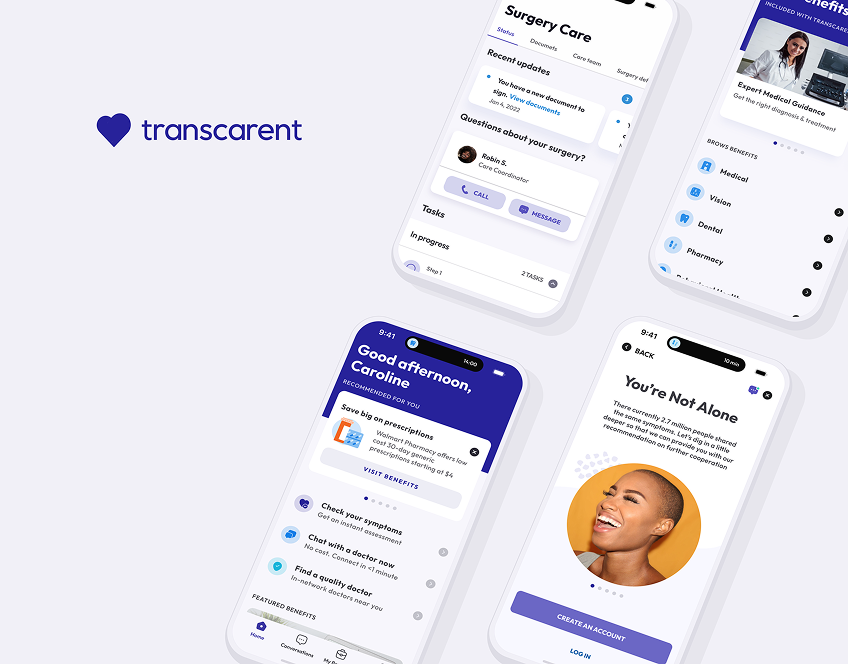
A consumer healthcare app integrating virtual care, providers, and local facilities, with a medicine-matching system. Result: 4.7 App Store rating, 24% saved by members on substitute medicines.